
As part of a local team of former dental service technicians, we at Cattani Australasia fully understand the risks of exposure to infection associated with dental suction systems.
As a result, we focus on a holistic approach to infection prevention and control to deliver world-class dental air.
“The Cattani legacy is the embodiment of where our quality comes from, and what we stand for today. From developing large installation modular solutions through to the development of disinfection products for dental suction to mitigate risks of infection to dental professionals, patients and maintenance staff, Cattani Australasia has been painstakingly refining precision performance to keep your surgery operating safely for more than 35 years in Australia.”
Mark Humphries
Your health and safety obligations
Those who operate in the dental health workspace are responsible not only for providing a safe environment in which dental care is delivered, but also for mitigating the risk of infection for everyone who uses or supports the operation of dental suction systems.
As patients and staff members that operate within this area are generally front of mind when it comes to infection prevention and control for dental suction systems, the duty of care extends to all the other individuals who may come in contact with the system.
This may include anyone who may enter the plant room. Keep in mind that suction systems within the plant room will undergo weekly and annual
routine maintenance as well as potential irregular maintenance, including the collection of amalgam retention containers for recycling purposes.
Differentiating products to be used on medical devices
As Cattani dental suction systems are medical devices, the disinfectants intended for use on Cattani plant equipment are heavily regulated. Cleaners intended for use on medical devices that do not claim to be a device disinfectant or sterilant are regulated as Class I medical devices.
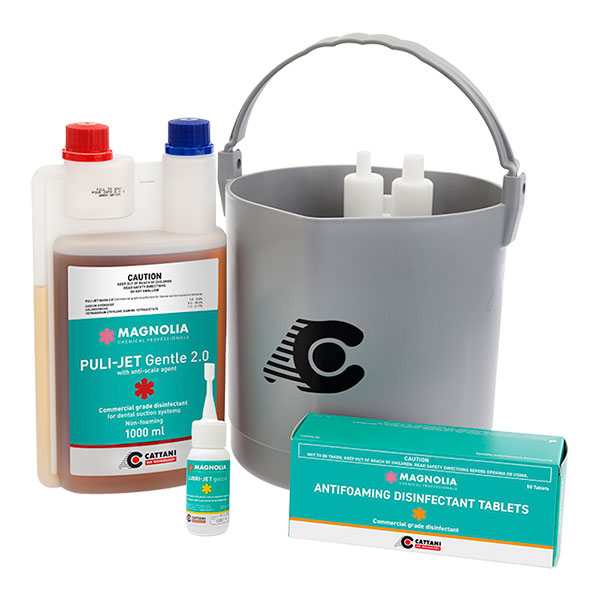
Liquids, sprays, wipes, and aerosols intended to be used on medical devices that make disinfectant or sterilant claims are regulated as Class IIb medical devices. Puli-Jet Gentle 2.0 is an example of a Class IIb medical device, registered as an antimicrobial solution made to disinfect dental medical devices.
Infection prevention and control considerations:
- Patients
- Staff who use and maintain the suction system
- Contractors who perform system maintenance on your plant room equipment
- Amalgam recycling contractors
Dental suction disinfection and its impact on suction performance
To ensure optimal suction performance in a dental surgery, it is crucial to plan thoroughly. From the gradient of the pipelines
From the distance between the suction unit and chair to selecting the appropriate disinfection solution, correct suction maintenance is an important part of keeping your surgery operating at its finest.
Whilst it is common practice to disinfect suction lines at the end of each working day, it is also wise to manage the risk of foam forming in the dental suction system. Foam management is critical, as it can be drawn into the suction motors, which can cause damage or even equipment failure if repeated over time, since this component is designed to always remain dry.
Within the dental suction system, foam could occur in several ways, including:
- certain dental treatments that have a large amount of dense liquids such as blood, mucus, and thick saliva; or
- using unsuitable detergents and cleaners containing ingredients that produce foam.
To address this, Antifoaming Disinfectant Tablets complement end-of-day suction maintenance for clinics that want an extra level of disinfection throughout the treatment day and the added benefit of managing foam to protect suction performance.
Conclusion
Dental suction system maintenance is about protecting your business asset, as much as infection prevention and control for all individuals that may
come into contact with the dental suction system. Only choose the approved disinfectant that meets your dental practice infection prevention and control requirements and is suitable for use with your dental suction system.